

What is Weaponized Incompetence?




-
1.https://www.mindbodygreen.com/articles/weaponized-incompetence
2. https://www.fatherly.com/life/what-is-weaponized-incompetence
3.https://www.theatlantic.com/sexes/archive/2013/03/the-difference-between-a-happy-marriage-and-miserable-one-chores/273615/
4.https://www.relationshipsnsw.org.au/balancing-the-mental-load-in-a-relationship/
5. https://www.youtube.com/watch?v=3r26trxV-dU&ab_channel=BrutAmerica
FAQ
What is weaponized incompetence?
Weaponized incompetence is a behaviour pattern when a partner pretends to be bad at a task so they don't have to do it. This can mean playing dumb, doing a task poorly, or deferring because "you're better at it than me." It typically occurs in cisgender, heterosexual relationships but is not limited to them. It can also happen at the workplace, where a colleague dumps tasks on others by implying "they have a knack for it," and in friendships, where one person shoulders all the planning.
What are the signs of Weaponized Incompetence?
Four warning signs: (1) repeated phrases like "I'm not good at that" or "You're better at it than me," (2) feeling manipulated — subtle oversights and gestures building over time, (3) feeling alone and not trusting your partner, intentionally not asking for help because you don't believe they'll follow through, and (4) burnout with zero growth — one partner constantly learning new skills while the other is content not to improve.
What happens if Weaponized Incompetence continues?
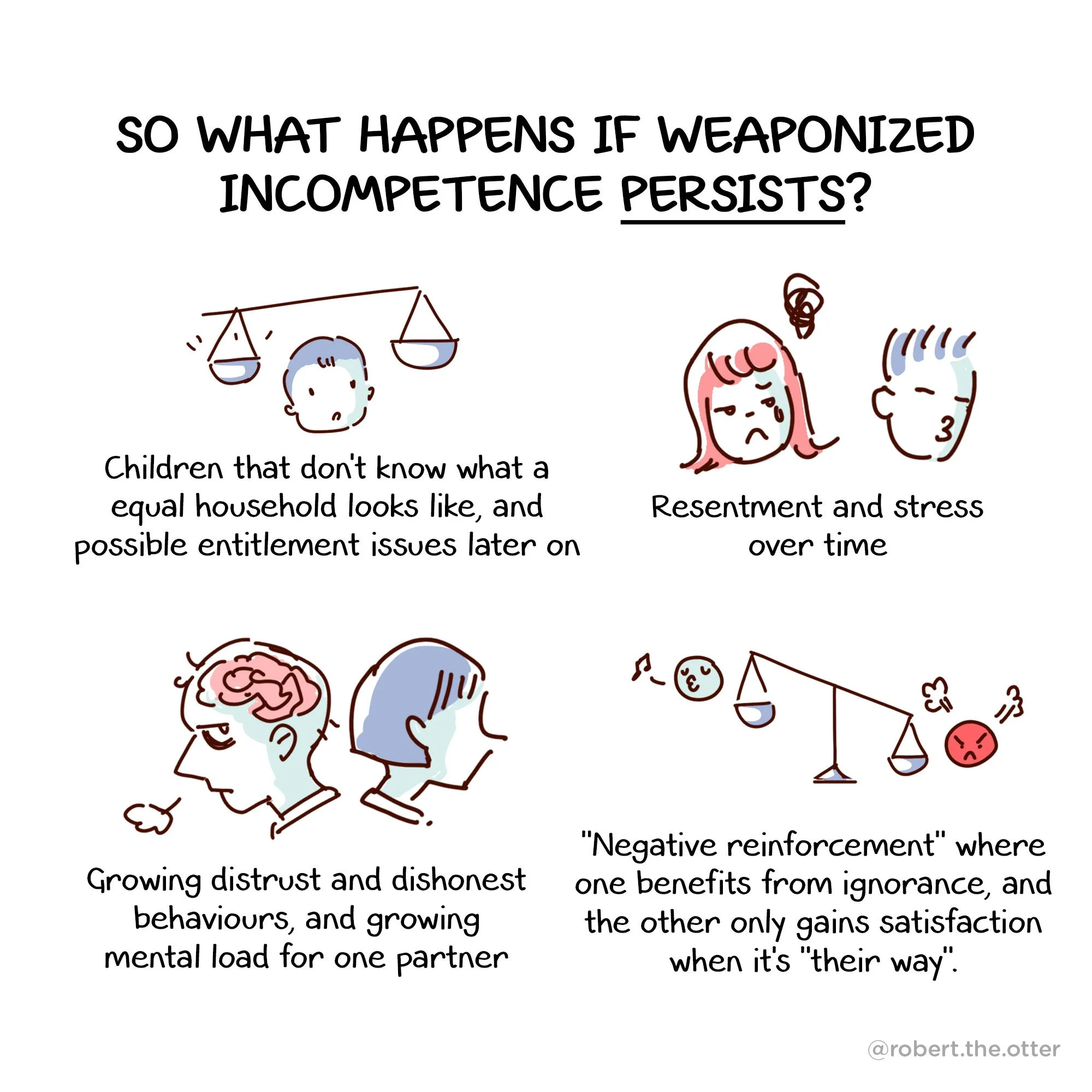
Children who don't know what an equal household looks like. Resentment and stress over time. Growing distrust and dishonest behaviours. Growing mental load for one partner. A negative reinforcement cycle where one person benefits from ignorance and the other only gains satisfaction when things are done "their way."
How do you deal with Weaponized Incompetence?
Three approaches: (1) open communication, with time — both partners need to be accountable and committed to change, (2) boundary setting and compromise — decide which chores need to be done a specific way and which you can be flexible on, and (3) improve by accruing knowledge — for men especially, break the pattern of allowing someone else to pick things up and dedicate yourself to improvement.
Is it Weaponized Incompetence or neurodivergence?
Not always manipulation. Sometimes an inability to do a task is caused by neurodivergence (ADHD, autism), past trauma, or decision paralysis. An excuse is not always manipulation — it can be an explanation. Investigate the reason before applying the label. Unravel these feelings slowly and with care.
FULL TRANSCRIPT
So I was at work the other day, and I overheard my colleagues in a heated discussion. "I know right! He cannot even wash and fold the laundry!" "He said, 'But you're better at it. Can't you do it?'" "Men! That's weaponized incompetence! Don't stand for it!"
Woa. I'd heard of incompetence but the weaponized variety!? Never. So I rushed home and decided to leap into my otter-man cave to research...and that's when my whiskers froze. Have I ever weaponized MY own incompetence!? Listen to this...
Weaponized Incompetence is a behaviour pattern when a partner pretends to be bad at a task so they don't have to do it. Sometimes this means playing dumb, doing a task poorly, or reverting to the other person because "you're better at it than me." "I can't find that lotion. Aiyaaa...I just wait for you k." "Look! I folded it like I promised byebye."
I suddenly flashbacked to my life as a colleague, husband and father. There were plenty of tasks I was horrible at! But had I done them intentionally bad so another person could do it? I had to know more.
Weaponized incompetence typically happens in cisgender, heterosexual relationships where males lean on their female partners. But this unfair dynamic is NOT limited to men. It can occur in various people and relationships.
At the workplace, a co-worker may expect subordinates to shoulder all the tasks they don't want to do. A colleague may imply that others should automatically do these tasks because they're a personality fit or "they have a knack for it."
In friendships, one person ends up shouldering all the planning for get-togethers. They're forced to do all the communication, research, scheduling, confirming, and other responsibilities. This experience is typically met with frustration over time, especially if no one steps up to help.
In relationships, this phenomenon is much more apparent between romantic partners and chores of the home. Especially when one partner has chosen not to improve, or finish a task from beginning to end. It can also happen subtly with one partner doing a task poorly because they are fearful of not doing it the "right way."
What does weaponized incompetence sound and feel like? Common phrases: "I am not good at doing that." "You're better at it than me." "I'm really busy right now, could you do it instead?" "I can't do this." "I think you should just do it."
Feelings of being manipulated. All give, very little compromise. This stems from a pattern that aims to uphold unequal and unfair power dynamics. Subtle oversights and gestures build over time. Just because weaponized incompetence can be silent and subconscious, it doesn't mean it isn't manipulative.
You feel alone and don't trust your partner. When you face difficult tasks, you intentionally don't ask for help because you do not trust the other partner. If you constantly feel alone, this can signify a major imbalance in the relationship.
You feel burnt-out with zero growth. Long-term distrust leads to exhaustion, and this eventually leads to resentment. One partner is constantly trying to learn new skills, while the other is content not to improve.
What happens if weaponized incompetence persists? Children that don't know what an equal household looks like, and possible entitlement issues later on. Resentment and stress over time. Growing distrust and dishonest behaviours, and growing mental load for one partner. Negative reinforcement where one benefits from ignorance, and the other only gains satisfaction when it's "their way."
How do you deal with weaponized incompetence? Open communication, with time. Experts and counsellors recommend that both partners are accountable and committed to change. Understand that some sacrifice and compromise is necessary to build a loving and caring relationship.
But wait. At the same time, we cannot also 100% assume that just because someone can't do a task, they're being manipulative. Sometimes an excuse isn't an excuse, but an explanation. Is it because of past experiences? Is one partner neurodivergent and finds a task especially difficult? Unravel these feelings slowly and with care.
Boundary setting and compromise, with understanding. Decide what chores need to be done in a specific way, and which chores you can compromise on. This sets up agreed-upon standards to ensure both partners are taking equal responsibilities.
Improve by accruing knowledge, for men especially. For men, the desire to accrue daily knowledge and navigate society is less ingrained from a young age. Most have been subtly trained to allow a woman to pick things up. But we can break these patterns and dedicate ourselves to improvement! And for the other partner, support their growth!
Wow. This was a bitter but necessary pill for me to take. Weaponized incompetence of any kind still has negative effects. And if it's a continued problem, even after being openly discussed, it can mean one thing: the other person doesn't want to improve the relationship.
But if we can navigate this with understanding and sensitivity, it can lead to, well, more intimacy! Woooo!
At the end of the day, we should always strive to understand each other more by trying to be better ourselves. Why? Well, some relationships are just too important not to.